
How to Play Spanish 21: Rules, Card Values & Best Strategy

Spanish 21 is a popular blackjack variation that removes all 10-value cards from the deck but compensates players with bonus payouts and favorable rules. Unlike traditional blackjack, this game uses Spanish decks of 48 cards each and offers unique betting opportunities that can actually provide better odds than standard blackjack in certain situations. Players can enjoy features like late surrender, doubling on any number of cards, and special bonuses for achieving 21 with five or more cards.
The game maintains the familiar goal of reaching 21 without going over while beating the dealer’s hand. However, Spanish 21 introduces several player-friendly rules that help offset the disadvantage of missing 10-value cards. These include allowing players to win automatically with 21, surrendering after doubling down, and receiving bonus payments for specific card combinations.
Understanding the basic mechanics, card values, and strategic differences from regular blackjack helps players make informed decisions at the table. The game offers both land-based and online versions, each with slightly different interfaces but identical core rules and betting structures.
Spanish 21 Basics
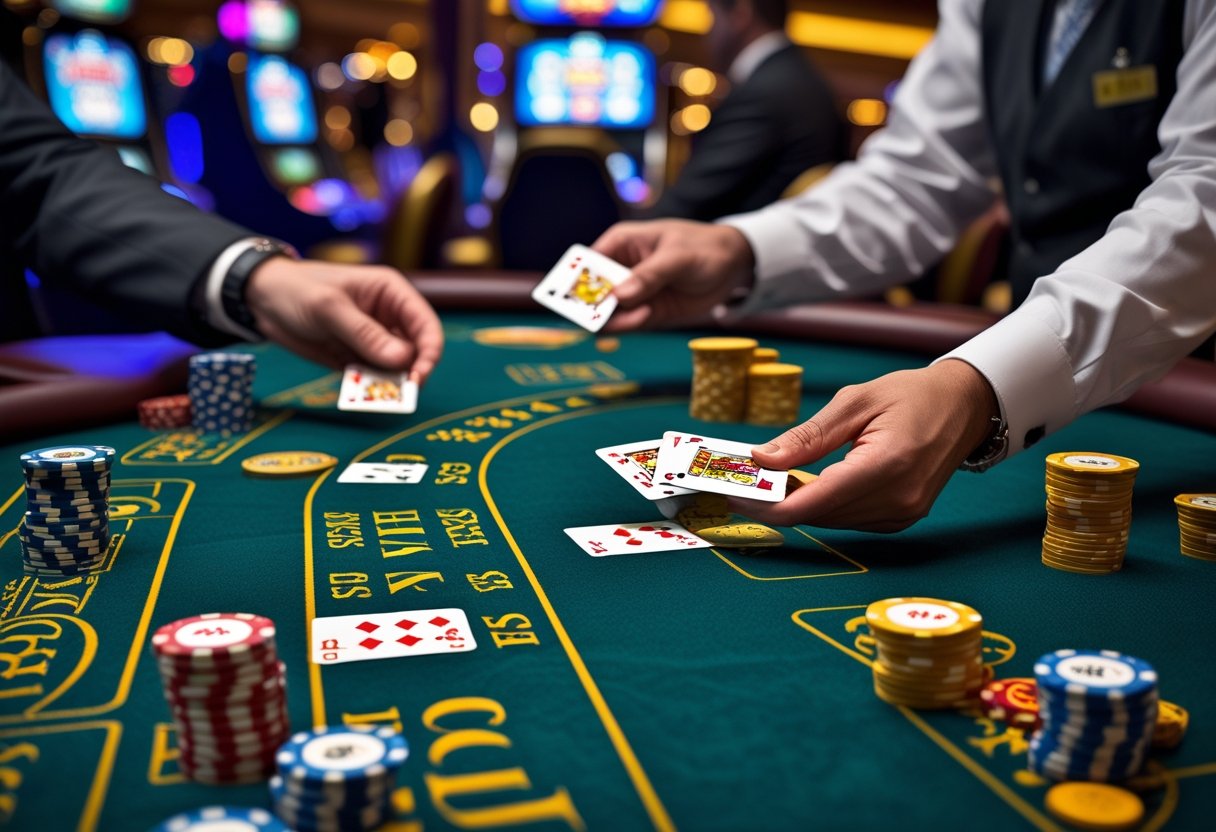
Spanish 21 is a blackjack variant that uses modified decks and offers unique player advantages. The game removes all 10-value cards except face cards and provides special bonus payouts for certain hands.
What Makes Spanish 21 Different from Traditional Blackjack
Spanish 21 differs from traditional blackjack in several key ways that favor the player. The most significant change is the deck composition, which removes all 10s while keeping face cards.
Player Advantages:
- Player 21 always beats dealer 21
- Players can double down on any number of cards
- Late surrender is allowed after doubling
- Players can hit and double after splitting aces
- Re-splitting aces is permitted
The game also offers bonus payouts for special hands. A five-card 21 pays 3 to 2, while a six-card 21 pays 2 to 1. Seven or more cards totaling 21 pay 3 to 1.
Special combination bonuses include 6-7-8 and 7-7-7 sequences. Mixed suits pay 3 to 2, same suit pays 2 to 1, and spades pay 3 to 1.
Objective of the Game
The objective in Spanish 21 remains the same as traditional blackjack. Players aim to get their cards as close to 21 as possible without going over.
Players must beat the dealer’s hand to win. They can achieve this by getting closer to 21 than the dealer or by having the dealer bust.
Unlike traditional blackjack, players automatically win with 21 regardless of the dealer’s hand. This rule eliminates pushes when both player and dealer have 21.
Spanish Deck Composition
Spanish 21 uses Spanish decks instead of standard playing cards. Each Spanish deck contains 48 cards rather than the usual 52 cards.
Cards Removed:
- All four 10s (10 of hearts, diamonds, clubs, spades)
Cards Included:
- Numbers 2 through 9
- Jacks, Queens, Kings (all worth 10 points)
- Aces (worth 1 or 11 points)
Most games use six or eight Spanish decks shuffled together. The removal of 10s increases the house edge since fewer 10-value cards remain in play.
Face cards retain their 10-point value despite the removal of numbered 10s. This means 16 ten-value cards remain in each Spanish deck instead of the usual 16 in a standard deck.
Spanish 21 Rules
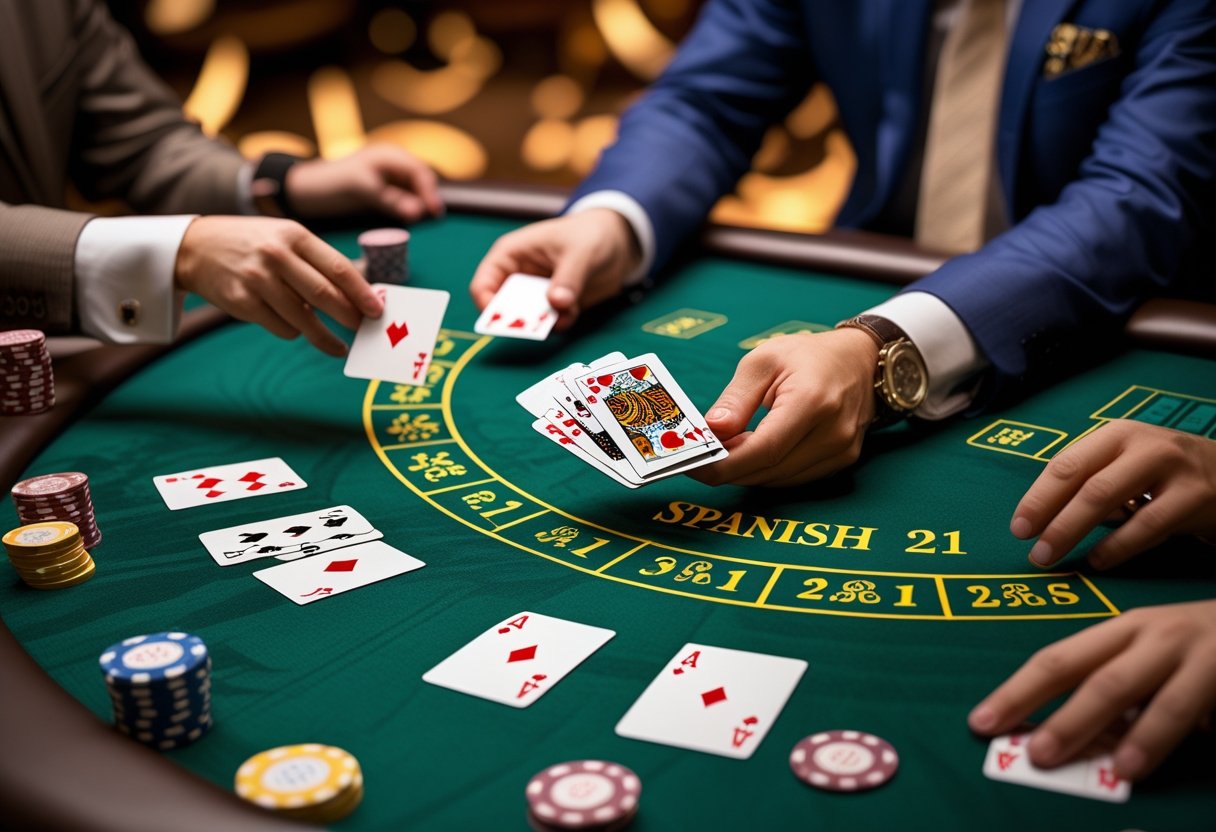
Spanish 21 uses special 48-card decks with all tens removed, creating unique gameplay dynamics where face cards still count as 10. Players aim to reach 21 without busting while the dealer follows specific hitting and standing rules.
Dealing and Gameplay Structure
Spanish 21 uses six or eight Spanish decks with 48 cards each. The game removes all four tens from standard decks but keeps face cards.
Each Spanish deck contains cards 2-9, Jack, Queen, King, and Ace. Face cards count as 10, while Aces count as 1 or 11.
Players place bets before receiving two face-up cards. The dealer gets one face-up card and one face-down card.
Players can hit, stand, double down, or split like regular blackjack. Spanish 21 allows doubling on any number of cards, not just the first two.
Key player options include:
- Late surrender allowed
- Double after split permitted
- Re-splitting aces allowed
- Hit and double after splitting aces
- Double down rescue (surrender after doubling)
Players must avoid exceeding 21 to prevent an automatic bust. The dealer plays their hand after all players complete their turns.
Winning Conditions and Payouts
Player 21 always beats dealer 21 in Spanish 21. Player blackjack also defeats dealer blackjack.
Special bonus payouts apply:
- Five-card 21 pays 3 to 2
- Six-card 21 pays 2 to 1
- Seven or more card 21 pays 3 to 1
Combination bonuses:
- 6-7-8 mixed suits: 3 to 2
- 6-7-8 same suit: 2 to 1
- 6-7-8 all spades: 3 to 1
The same payouts apply to 7-7-7 combinations. Suited 7-7-7 with dealer showing 7 triggers the Super Bonus.
Players win $1,000 for bets $5-$24 or $5,000 for bets $25 and up. Other players receive $50 envy bonuses.
Bonus payouts don’t apply after doubling down. Most casinos also exclude bonuses after splitting.
Dealer Rules
The dealer must hit on hand totals of 16 or less. Dealer rules for soft 17 vary by casino location.
Some casinos require dealers to hit soft 17. Others make dealers stand on soft 17, which reduces the house edge.
The dealer reveals their hole card after players finish. If the dealer busts by exceeding 21, remaining players win automatically.
Dealer blackjack beats all player hands except player blackjack or player 21. The dealer collects losing bets and pays winners according to the payout schedule.
Players can observe dealer tendencies but cannot influence dealer decisions. The dealer follows fixed rules without strategy choices.

Card Values in Spanish 21
Spanish 21 uses a unique 48-card deck system where all tens are removed, but card values remain mostly the same as traditional blackjack. The key difference lies in how players can use these values with more flexible rules.
Numeric Card Values
Cards numbered 2 through 9 keep their face value in Spanish 21. A 2 equals 2 points, a 3 equals 3 points, and so on up to 9.
These cards work exactly like they do in regular blackjack. Players add them together to reach their hand total.
The removal of 10-value cards from the deck means numeric cards appear more often. This changes the odds but not the basic counting system.
Players still aim to get as close to 21 as possible. The numeric cards form the foundation of most hands in Spanish 21.
Face Cards and Aces
Face cards (Jacks, Queens, and Kings) all count as 10 points each. Even though the numbered 10 cards are removed from Spanish decks, these face cards stay in play.
This means there are still twelve 10-value cards in each 48-card deck. Face cards work the same way they do in traditional blackjack.
Aces can count as either 1 or 11 points. Players choose whichever value helps their hand the most.
An Ace starts as 11 points. If adding another card would make the total go over 21, the Ace automatically becomes worth 1 point instead.
A hand with an Ace counting as 11 is called a “soft” hand. When the Ace must count as 1, it becomes a “hard” hand.
Spanish 21 Card Values vs. Other Games
Spanish 21 card values match traditional blackjack exactly. The difference is not in how cards count, but in which cards exist in the deck.
Regular blackjack uses 52-card decks. Spanish 21 removes all four 10-value number cards, leaving 48 cards per deck.
| Card Type | Spanish 21 Value | Regular Blackjack Value |
|---|---|---|
| 2-9 | Face value | Face value |
| J, Q, K | 10 points each | 10 points each |
| Ace | 1 or 11 | 1 or 11 |
| 10 | Not in deck | 10 points |
This removal makes it harder to get 20 or 21. Spanish 21 makes up for this with bonus payouts and player-friendly rules that other blackjack games don’t offer.
Player Actions
Spanish 21 gives players more flexibility than regular blackjack with unique options like double down rescue and late surrender. Players can make strategic decisions on every hand that can significantly impact their chances of winning.
Hit and Stand
Players can hit to take another card or stand to keep their current total. The basic goal is to get as close to 21 as possible without going over.
In Spanish 21, players can hit on any hand total. This includes hands that might seem risky in regular blackjack.
Key hitting rules:
- Players can hit multiple times on most hands
- Players can usually hit after splitting aces
- A player 21 always beats a dealer 21
The strategy for hitting differs from regular blackjack. Players might hit on totals like 17 when holding three or more cards against a dealer ace.
Standing works the same as regular blackjack. Players signal they want no more cards and keep their current hand total.
Splitting Pairs
Players can split pairs when they receive two cards of the same rank. This creates two separate hands that each need their own bet.
Spanish 21 offers better splitting rules than most blackjack games. Players can re-split aces at most casinos.
Splitting advantages:
- Re-splitting aces is usually allowed
- Players can double after splitting
- Players can hit after splitting aces
Each split hand plays independently. Players make decisions for one hand before moving to the next.
Most casinos allow players to split up to three times. This means one pair can become four separate hands.
Doubling Down and Double Down Rescue
Doubling down lets players double their bet and receive exactly one more card. Spanish 21 allows doubling on any number of cards.
This rule gives players more opportunities than regular blackjack. They can double after taking several hits if the situation is right.
Double down rescue is unique to Spanish 21. Players can surrender after doubling down and lose only their original bet.
The rescue option works like this:
- Player doubles down and receives one card
- If the hand looks bad, player can surrender
- Player loses the original bet but gets the double portion back
This rule reduces risk when doubling. Players can take more aggressive doubling chances knowing they have an escape option.
Late Surrender
Late surrender allows players to give up their hand after the dealer checks for blackjack. Players lose half their bet but save the other half.
Players can surrender on their first two cards in most situations. Some casinos also allow surrender after doubling down.
When to consider surrender:
- Hard 16 against dealer 10 or ace
- Hard 15 against dealer 10
- Some soft hands in specific situations
Surrender is not available after splitting or taking hits. Players must decide before taking any other action on their hand.
The surrender option helps reduce losses on very weak hands. Smart use of surrender can lower the house edge significantly.
Bonus Payouts and Side Bets
Spanish 21 offers automatic bonus payouts for special 21 combinations and popular side bets like Match the Dealer. These features provide extra winning opportunities beyond the standard blackjack payouts.
Super Bonus and 21 Bonuses
The Super Bonus is an automatic payout that requires no additional wager. Players receive this bonus when they hit 21 with specific card combinations.
A player wins the Super Bonus by getting 21 with three suited 7s while the dealer shows a 7. The payout depends on the original bet size.
Super Bonus Payouts:
- Bet under $25: $1,000 fixed payout
- Bet $25 or more: $5,000 fixed payout
Other bonus payouts apply to different 21 combinations. Five-card 21s pay 3 to 2. Six-card 21s pay 2 to 1.
Seven or more cards totaling 21 pay 3 to 1. These bonuses reward players for hitting multiple small cards instead of busting.
Match the Dealer and Envy Bonus
Match the Dealer is the most common side bet in Spanish 21. Players win when their first two cards match the dealer’s upcard in rank.
A non-suited match pays 4 to 1. A suited match pays 9 to 1 or higher.
If both player cards match the dealer’s upcard, each match pays separately. This creates multiple winning opportunities on a single hand.
Match the Dealer Payouts:
- One non-suited match: 4 to 1
- One suited match: 9 to 1
- Two matches: Both paid individually
The Envy Bonus appears at some tables with Match the Dealer. When another player hits a suited match, all other players with the side bet win a small bonus.
Insurance and Insurance Bet
Insurance works the same way as regular blackjack. When the dealer shows an Ace, players can make an insurance bet up to half their original wager.
The insurance bet pays 2 to 1 if the dealer has blackjack. If the dealer doesn’t have blackjack, the insurance bet loses.
Insurance has a high house edge in Spanish 21. The removal of 10s from the deck makes dealer blackjack less likely.
Most strategy experts recommend avoiding insurance bets. The math doesn’t favor the player even with the modified deck composition.
Smart players focus on the main game and automatic bonuses instead of side bets with poor odds.
Strategy and House Edge
Spanish 21 offers one of the lowest house edges in the casino when played correctly, typically ranging from 0.40% to 0.76%. Players can achieve optimal results by following basic strategy charts and understanding the game’s unique bonus payouts.
House Edge and Return to Player
The house edge in Spanish 21 varies based on specific rules. When the dealer stands on soft 17, the house edge drops to 0.40%.
If the dealer hits on soft 17 with redoubling allowed, the edge increases slightly to 0.42%. Without redoubling allowed, it jumps to 0.76%.
These figures assume perfect basic strategy play. Without proper strategy, the house edge can exceed 2%.
The removal of 10-value cards from Spanish decks naturally favors the house. However, the player-friendly rules and bonus payouts more than compensate for this disadvantage.
Players should always seek tables where the dealer stands on soft 17. This single rule change can save money over time.
Spanish 21 Basic Strategy Chart
Spanish 21 strategy differs significantly from regular blackjack due to the missing 10s and bonus rules. Players must adjust their decisions accordingly.
Key Strategy Differences:
- Hit 17 against dealer ace when holding 3+ cards
- Double down more aggressively due to bonus payouts
- Split pairs more frequently than in regular blackjack
- Use surrender option liberally, especially after doubling
Players should never stand on soft 17 or 18 against strong dealer cards. The bonus payouts for 5-card, 6-card, and 7+ card hands encourage hitting in borderline situations.
Always remember: Player 21 beats dealer 21 in Spanish 21. This rule alone changes many basic strategy decisions.
The double down rescue feature allows players to surrender after doubling. This reduces risk in marginal doubling situations.
Tips for Minimizing Losses
Bankroll management remains crucial in Spanish 21. Set strict loss limits before playing and stick to them.
Focus on bonus opportunities without chasing them recklessly. The 6-7-8 and 7-7-7 combinations offer excellent payouts when they occur naturally.
Avoid the Match the Dealer side bet. The house edge ranges from 3.06% to 14.48% depending on the pay table.
Practice basic strategy until it becomes automatic. Even small deviations can increase the house edge significantly.
Look for tables with favorable rules like redoubling allowed and dealer stands on soft 17. These options directly impact your expected return.
Never take insurance bets. The missing 10-value cards make insurance an even worse proposition than in regular blackjack.
How to Play Spanish 21 Online
Playing Spanish 21 online moves faster than physical casino games and offers more convenience through digital interfaces. Players can access games instantly from home while enjoying clear visual displays and automated dealing.
Differences Between Online and Land-Based Play
Online Spanish 21 games move at a much faster pace than land-based versions. Cards are shuffled automatically and dealt instantly without waiting for other players or dealer actions.
The digital interface shows all information clearly on screen. Players can see their hand total, the dealer’s upcard, and available action buttons like Hit, Stand, and Double Down.
Key online features include:
- Automatic card shuffling between hands
- Instant dealing with no physical delays
- Clear display of hand totals and betting options
- No pressure from other players at the table
Online games use random number generators to ensure fair card distribution. This eliminates concerns about dealer mistakes or card handling issues.
Players can take more time to make decisions without feeling rushed. The game waits for player input before continuing.
Best Practices for Digital Play
Players should start with free demo versions before betting real money. This allows practice with the digital interface and game controls without financial risk.
Essential tips for online play:
- Set betting limits before starting each session
- Use the game’s built-in strategy charts when available
- Take advantage of slower pace to make careful decisions
- Keep track of bankroll through session statistics
Players should verify their internet connection is stable before starting. Connection issues during hands can cause problems with betting and card actions.
Many online games offer helpful features like hand history and statistical tracking. These tools help players review their performance and identify areas for improvement.
The auto-play feature should be used carefully. Players maintain better control by making each decision manually rather than relying on automated choices.
Top Platforms for Playing Spanish 21 Online
Leading online casinos for Spanish 21:
| Platform | Key Features |
|---|---|
| 888 Casino | User-friendly interface, excellent customer support |
| Betway | Secure environment, live dealer options |
| LeoVegas | Strong mobile gaming experience |
| DraftKings Casino | Multiple Spanish 21 variations available |
Players should verify that chosen platforms hold proper gaming licenses. Look for regulation by authorities like the UK Gambling Commission or Malta Gaming Authority.
Safety checklist for online platforms:
- SSL encryption for data protection
- Random number generator certification
- Clear privacy policies
- Responsive customer support
- Positive user reviews and ratings
Many platforms offer welcome bonuses specifically for table games. These can provide extra value for Spanish 21 players but come with wagering requirements.
Mobile compatibility is important for players who want flexibility. The best platforms offer smooth gameplay across desktop and mobile devices.
Frequently Asked Questions
Players often ask about basic strategy decisions and how Spanish 21 differs from regular blackjack. The game has unique rules that affect both the house edge and winning strategies compared to traditional blackjack.
What is the basic strategy for Spanish 21?
Players should hit more often in Spanish 21 than in regular blackjack. This happens because the deck has no 10-value cards except face cards.
Hit on hard 17 when the dealer shows an ace and you have three or more cards. Many players find this strange, but it saves about 2.8% of the initial bet.
Double down on more hands than you would in blackjack. The game allows doubling after any number of cards, not just the first two.
Always take surrender when it helps your odds. Spanish 21 offers late surrender, which gives players more ways to cut losses.
Split aces when allowed since you can usually hit and double after splitting them. This rule gives players a big advantage over the house.
Can you provide a step-by-step guide for beginners to learn Spanish 21?
Start by learning that Spanish 21 uses decks with 48 cards each. The four 10-value cards are removed from each deck.
Place your bet before cards are dealt. The dealer gives each player two cards face up and takes one card face up for themselves.
Add up your cards to get as close to 21 as possible without going over. Aces count as 1 or 11, face cards count as 10, and other cards count at face value.
Choose to hit, stand, double, split, or surrender based on your cards and the dealer’s up card. You can double on any number of cards in Spanish 21.
Remember that your 21 always beats the dealer’s 21. This rule helps make up for the missing 10-value cards.
Watch for bonus payouts on special hands like five-card 21 or suited 6-7-8. These bonuses only pay if you don’t double down.
What are the key differences between Spanish 21 and traditional blackjack?
Spanish 21 removes all four 10-value cards from each deck. Regular blackjack uses standard 52-card decks with all tens included.
Player 21 always wins in Spanish 21, even when the dealer also has 21. In regular blackjack, this would be a push where no money changes hands.
Players can double down on any number of cards in Spanish 21. Most blackjack games only allow doubling on the first two cards.
Spanish 21 offers special bonus payouts for certain hands. Five-card 21 pays 3 to 2, six-card 21 pays 2 to 1, and seven or more card 21 pays 3 to 1.
Late surrender is standard in Spanish 21 but rare in blackjack. Players can also surrender after doubling, called “double down rescue.”
Players can usually hit and double after splitting aces in Spanish 21. Most blackjack games don’t allow any action after splitting aces.
How does the house edge in Spanish 21 compare to classic blackjack odds?
Spanish 21 has a house edge between 0.40% and 0.76% depending on the rules. This compares well to blackjack games with similar rules.
When the dealer stands on soft 17, Spanish 21 has a 0.40% house edge. This beats many blackjack games in casinos today.
The house edge goes up to 0.76% when the dealer hits soft 17 and redoubling isn’t allowed. This is still reasonable compared to other casino games.
Blackjack typically has a house edge between 0.28% and 0.60% with basic strategy. The exact number depends on the specific rules used.
Spanish 21 can actually be better than blackjack in some casinos. This happens when blackjack has bad rules like 6-to-5 payouts for natural 21.
What are the probabilities of winning in a game of Spanish 21?
The Super Bonus for suited 7-7-7 against a dealer 7 happens once in every 668,382 hands with six decks. With eight decks, it happens once in every 549,188 hands.
Players win about 43% of hands, lose about 48% of hands, and push on about 9% of hands. These numbers change slightly based on the specific rules used.
Five-card 21 happens roughly once in every 400 hands. Six-card 21 is much rarer at about once in every 4,000 hands.
Getting a suited 6-7-8 or 7-7-7 happens about once in every 1,400 hands. The same-suit version is much less likely.
Bonus hands make up for the missing 10-value cards by giving extra payouts. Without these bonuses, removing the tens would make the game much worse for players.
Are there any strategy cards or cheat sheets that can help in playing Spanish 21 effectively?
Basic strategy charts exist for Spanish 21 just like they do for blackjack. These charts show the best play for every possible hand.
Different charts apply based on whether the dealer hits or stands on soft 17. Charts also vary if the casino allows redoubling.
Strategy cards for Spanish 21 tell players to hit more often than blackjack charts do. This accounts for the missing 10-value cards in the deck.
Many casinos allow players to use strategy cards at the table. Check with the dealer before pulling out a card to make sure it’s okay.
Online strategy charts are available from gambling experts and mathematicians. Look for charts that match the exact rules of the game you’re playing.
The key difference from blackjack strategy is hitting more marginal hands. Players need to be more aggressive because fewer cards will bust their hand.